
Exemption Screening
Work Requirement Exemptions Identified From Data Your Agency Already Holds
Amorphic HHS 360 resolves constituent identity across agency systems, screens records against the exemption categories the state’s own data can support, and assembles the evidence behind each apparent match for a caseworker to determine. The policy rules stay separate from the data, so when requirements change, the update is quick to make and easy to trace.
Your data. Your AWS account. Your rules. Auditable from day one.
The Data Exists. The Infrastructure to Use It Doesn’t.

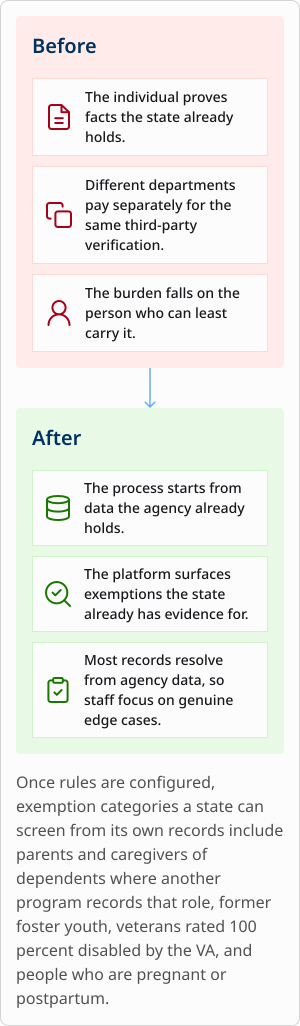
The state owns the data. It asks the person to prove it anyway.

A policy changes. Every file gets manually reprocessed.
Across states, a large share of people lose benefits for procedural reasons: missed paperwork, failed reverification, or administrative mismatch, not because they stopped qualifying.
In New Hampshire’s 2019 work requirement, the state cleared far more people from labor data it already held than managed to self-report their hours. The data to spare someone the paperwork chase usually exists inside the agency.
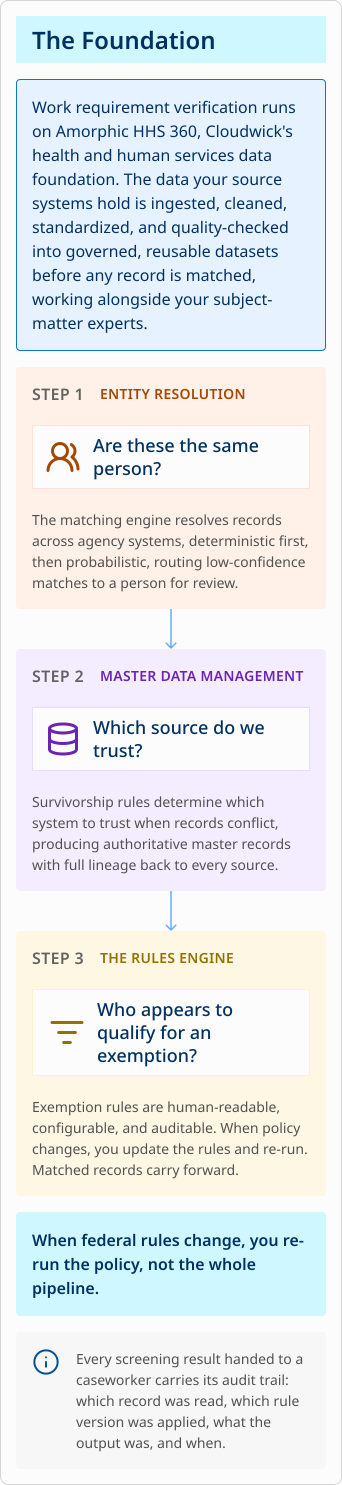
One Foundation. Three Steps That Stay Separate by Design.
In the eligibility systems we have seen, three things that need to be separate are usually tangled together. Keeping them distinct is what makes the system adaptable when requirements change.
The Burden of Proof Shifts From the Person to the System.

Buy Third-Party Data Last.
Agencies pay third-party vendors to verify facts the state already holds, and pay more than once: different departments buy the same verification, separately, for the same person. Third-party data has a role, but it belongs at the end of the process. Start with what the agency already owns, and outside lookups become the exception, bought only for what the agency genuinely does not have.
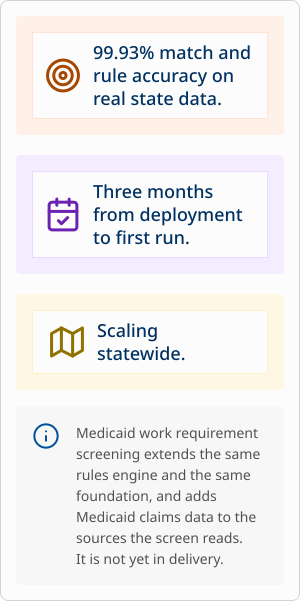
Proven on Real State Data, Now in Delivery.
Cloudwick is delivering SNAP work requirement verification for a state health and human services agency under a signed agreement, with agency data flowing since August 2026.
The Agency Determines. The Platform Identifies and Assembles.
The agency determines eligibility and exemptions. The platform identifies who appears to qualify and assembles the supporting evidence. Federal law sets that division (42 CFR 431.10(c)(2)), so no vendor’s system makes the call. Every screening output and rule version is logged so the state can show how a result was assembled if a determination is appealed.
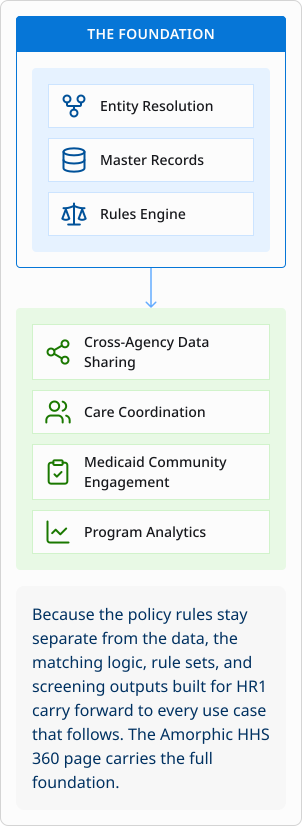
The Foundation Built for HR1 Carries Every Program That Follows.
Wherever You Are With HR1, This Works With What You Have.
Many states are already down the road on HR1. Some of those approaches are costly to run, hard to change when rules shift, and dependent on outside data vendors. This foundation can sit underneath what you have already built, automate more of it, lean on the data you already own, and hold up the next time policy shifts.
Cloudwick deploys into the agency’s own AWS account. You own the data, the encryption keys, and the access controls.
