
Amorphic Education 360
Are Schools Improving?
Did Training Work? Which Child Needs a Meal? The Answers Are in Your Data
Are Schools Improving?
Did Training Work? Which Child Needs a Meal? The Answers Are in Your District Data
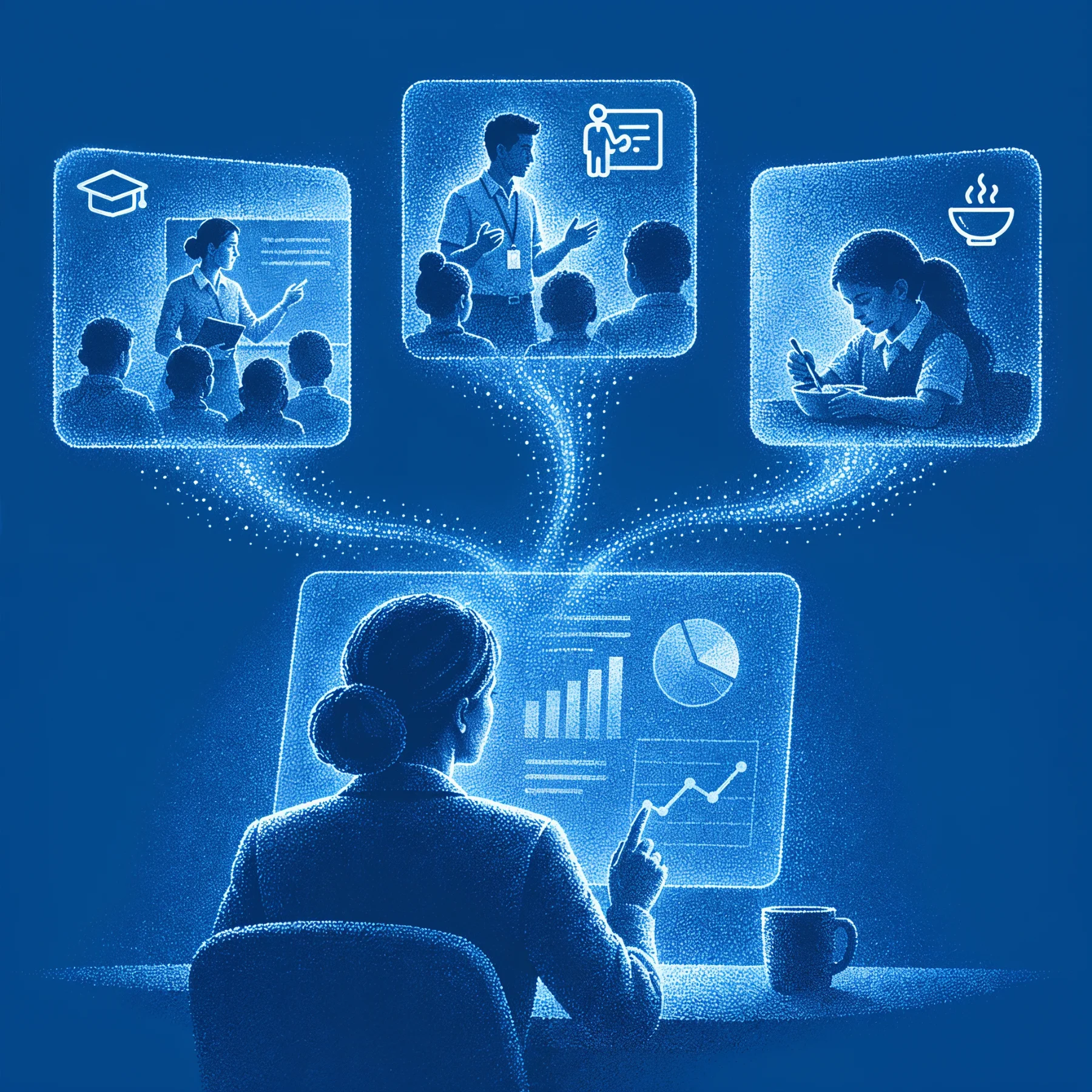
Amorphic Education 360 makes the data your districts already send comparable across district lines, tracks each student as one record when they move, and gives every program one governed dataset to work from, in your own AWS account.
The Problem
A child qualifies for a free school meal and doesn’t take one. The district loses funding on that child’s behalf. Finding those children means reading eligibility records next to participation records, two systems that were never built to be read together.
Every question that crosses a program line works the same way. Assembled by hand. Answered after the decision that needed it.

A student who moves appears twice in the data. The history that should follow her stops at the old district.

A cross-program question becomes a project: exports, extracts, and a hand reconciliation that produces a number nobody can reproduce next quarter.

Every new dashboard arrives with its own copy of the data and its own definitions, making the next question harder to answer than the last.
Two Things That Have to Happen First
Before any cross-program question can be answered, two things have to be true: district data has to mean the same thing across districts, and a student who moves has to carry one record.
01Reconciliation
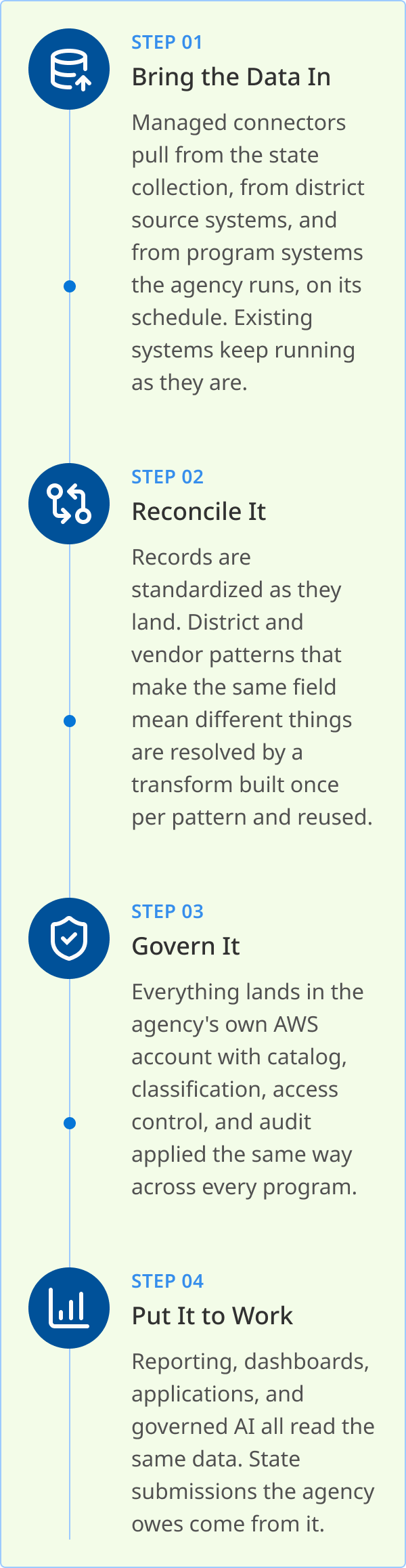
Each district fills the state form correctly, in its own way. The same field means something slightly different across districts. Fixing that one record at a time produces thousands of corrections.
Education 360 finds the patterns. A school sample resolves district variation into a finite set of repeating cases. One reusable transform handles each. Every district using that software gets the same fix.
02Identity Across District Lines
When a student changes districts, she often appears twice in the data. The history that should follow her stops at the old district.
Education 360 links records across district lines using configurable matching rules. Uncertain matches route to your staff, not an automated decision. Rules, scoring, and thresholds are set to your data and data-sharing agreements during implementation.
How It Works
What It Answers

Meal Eligibility
Eligibility and participation data in the same governed place. Children who qualify for a meal and are not taking one can be listed by school, so programs can act.

School Performance
When records mean the same thing from district to district, the agency can compare schools on consistent definitions, see which are improving, and investigate why.

Educator Development
Training records and student results on the same foundation let the agency see whether the training it purchased changed what happened in classrooms.

Reading Plans and
Early Warning
Reading plan and early warning applications read current student data from the foundation to flag students who need a plan or an intervention. This use case runs in production today.
Where It Runs Today
Education 360 runs in production in a statewide deployment scaling across the state today. Reading and early warning applications read from its foundation. District variation resolved into roughly 22 repeating patterns from a school sample, one transform each. The work rebuilt roughly three years of district data in months.
The same platform runs in production for large agencies in other domains. One state agency automated data ingestion, standardized and cleansed its data, and governed it for analytics, with an estimated $35 million in cost savings over five years from Cloudwick’s published case study. Entity resolution on the same platform is in use across state benefit programs at the scale of millions of participants.
Why Cloudwick

Deploys in Your Own AWS Account
Your agency owns the data, the keys, and every access control. Student data does not leave your environment.

A Comparability Analysis Comes Before Any Build
It inspects data across your districts, shows how definitions actually vary, and sizes the reconciliation work before anyone commits.

Nothing Is Turnkey
Source connections, reconciliation transforms, match rules, and access policies are all implementation work. A person stays on every AI-assisted decision.

Three Operating Models
Cloudwick operates the platform on your behalf, runs alongside your team while capacity builds, or hands the platform to your team to manage.
Start with one question.
Bring us a question your people are already asking, like which schools are improving once every district’s data means the same thing. A thirty-minute walkthrough against your own programs is the place to start. The data brought in for that first question stays for every question after it.
